

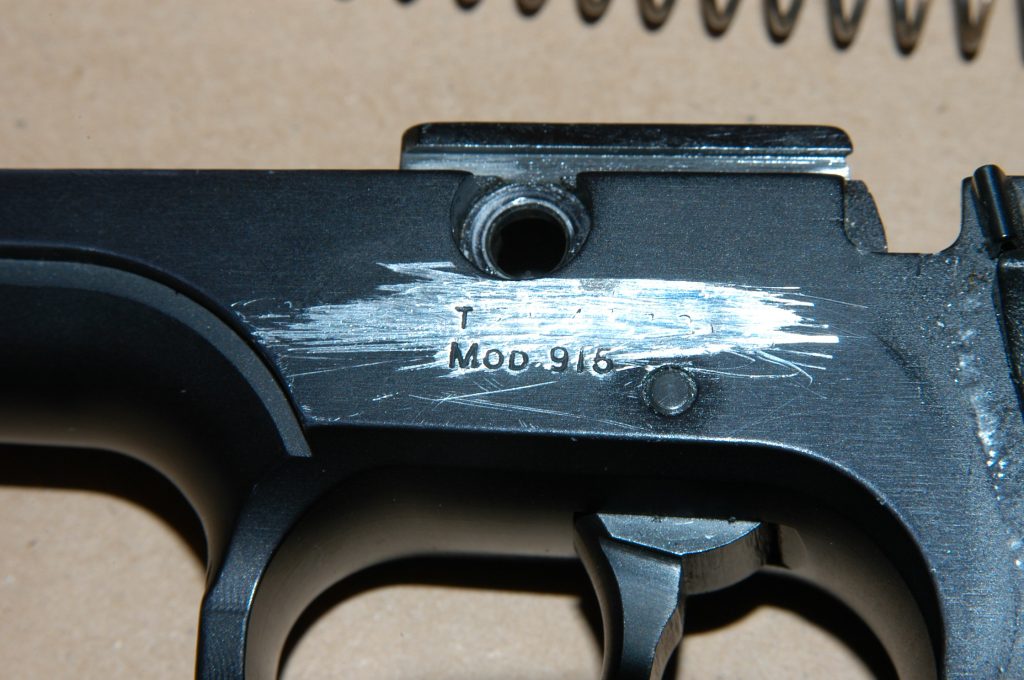
Jonathan argues that using terminology such as ‘illegal firearms’ directly contributes to why the fight for firearm rights is on the back foot in South Africa. Instead, he says that we need to understand the tactics of our opponents, and correct and educate others about why we need to be truthful. Building on this earlier article over at the Rational Standard some years ago, he argues why we should not let oversimplified narratives go unchallenged.
Firearm ownership is made intentionally difficult by the FCA. The government admitted it very clearly by saying that the goal was to make legal firearm ownership as expensive and difficult as possible, in order to deal with the problem of illegal firearms. As much as it has succeeded in some respects, there remains a desire and hunger among South Africans for lawful firearm ownership.
Unfortunately, the FCA has also had the effect of creating a sense of elitism by wealthier groups who care only for their own narrow purposes. For argument’s sake (although it is also true), there are people who would not bat an eye at the thought of more restrictions on handguns, as long as their hunting rifles or shotguns are left alone. There are others who will support restrictions on people who are not ‘serious’ enough about firearm ownership (firearm and ammunition limits for people without dedicated status is a clear example).
The thought of poor people with firearms unfortunately also makes many people uncomfortable. Even for those who no problem with it in principle, the crime hotspots of many townships are an uncomfortable reality that is not easily separated from honest people who would like to have their own firearms. This comes down to criminals using ‘illegal firearms’.
These are examples of the social and even cultural problems that exist within the broader firearm community in South Africa, and it all stems from this narrative of ‘illegal firearms’. The anti-gun brigade has been very effective at pushing this narrative, and their job has been made easier by the fact that people would like simple answers to very complex questions. If all the evils of crime can be put down to a clearly identified object, then all these evils can (theoretically) be eradicated overnight if we just deal with that object. That is the simple narrative, and its enormous problems are ignored.
There is simply no such thing as an ‘illegal firearm’. Every firearm is an object devoid of any morality or consciousness. It is just a thing. To use the exact same logic to describe ‘illegal knives’ or ‘illegal screwdrivers’ is ridiculous, and anyone trying to do that should be ridiculed and laughed at (yet there are people like this, such as UK politicians in London). The characterisation of a firearm as being ‘illegal’ is designed and intended to make it an evil object in and of itself. It is meant to separate the object from the evil intent of the person using it.
The only distinction is between lawful and unlawful possession, because evil people without an ‘illegal firearm’ will still do evil things. The anti-gun brigade could not care less about the evil person and what he does, as long as he does not use a firearm to do it. They have never cared much for the intent of the criminal’s mind, because they are fixated on the tool he uses. They focus on the symptom, not the cause. No serious person would argue that the most violent township will become a peaceful place of green grass and flowers if all the ‘illegal firearms’ are removed. If all the criminals are caught and removed…that will produce the peaceful place it needs to be for people to live in security.
Firearms attract the attention of the anti-gun brigade (and others) because they possess a significant intimidation factor by being loud and flashy. It is therefore easy to say that they represent evil people. Knives on the other hand are silent and do not attract the same attention, yet there is no anti-knife organisation in South Africa.
Returning to the problem of the term ‘illegal firearms’, this dichotomy is made possible by the arbitrary record keeping at the Central Firearms Registry. If a firearm it is not on their list, then it is ‘illegal’. Whether the person has a good reason for possessing it or not is completely irrelevant (such as self-defence and being too poor to afford the expensive competency process). It does not matter if the firearm is safely locked away in a safe on a farm where it has been since 1936 (before there was a register).
Unfortunately, the majority of the public and even the firearm owning community have swallowed this narrative hook, line, and sinker. They prove this whenever they say things such as ‘first deal with the illegal firearms then worry about legal ones’. The mere use of the words ‘illegal firearms’ is proof enough that a person at least partially believes and supports this flawed argument. The problem of ‘illegal firearms’ was never designed to actually be solved. The only way it will ever be ‘solved’ is to start with the ‘legal firearms’. Your firearms.
The anti-gun brigade has made this clear, to the point of drawing pictures to illustrate how firearm owners specifically are the problem. As long as there are firearms in society (private or government), there will always be a ‘diversion’ or ‘leak’ from the ‘legal pool to the illegal pool’. As long as there is even the mere potential of a leak, the crusade for more control will be justified. This is true even though criminals will always be able to obtain firearms from somewhere. This is what is meant by ‘firearms control’. Are you getting the message yet?
The word ‘control’ is a perfect and total word. Striving for it is impossible, because nothing anywhere near perfection can be achieved on this topic (or most topics for that matter). The notion of control over firearms is pure hubris, but making any kind of progress towards it by definition must start with ‘legal firearms’, whether it is hubris or not. This project for control is a total and all-encompassing project in the naïve belief that the criminal acquisition of firearms from that ‘somewhere’ can be cut off. It is global in its scope, and hopelessly optimistic in its nature. It is the definition of hubris.
Does this mean to say that ‘illegal firearms’ are not a problem that must be addressed? Yes, that is exactly what it says. How can anyone reasonably look at a violent criminal with a firearm and say ‘yes, that firearm is the problem’? Of course, the average person would say that both are a problem, even though the criminal is the only one with a conscious desire to cause harm. This is not sustainable logic.
What about home manufacture of firearms, especially now that 3D printing technology has come as far as it has? The anti-gun brigade has the same answer they do to everything else: just make more laws. Problem solved. Consider their victory conditions because of their focus on firearm as an object: if the use of firearms in violent crime dropped to zero, but the violent crime rate stayed the same, they would declare victory.
The anti-gun brigade suggests that if firearms are used in 30% of murder, then the murder rate will drop by 30% if firearms are removed from everyone. If this is not their argument, then why are they arguing it at all? The murder rate cannot logically decrease in this case because the criminal intent is still present. The firearm as a tool will simply be changed for another tool.
There is a reason that the courts do not consider the weapon as one of the five elements of a crime when convicting someone (conduct, causation, harm, fault, intent), because intent is far more important. It would be good if someone who wanted to kill you did not have a weapon, but it would be better if they did not want to kill you in the first place!
Crime is a deeply social and cultural problem, and laws on their own do not affect it much at all. Proper enforcement does, but this must not be confused with enforcing all laws. If violent crime is properly policed and responded to, and the reasons for violent crime are addressed (unemployment and desperation), violent crime of all types will naturally decrease even if there are no laws about weapons.
The United States has more firearms than it does people (over 350 million), yet it has a national homicide rate of around 6 per 100,000 people (and this varies wildly between each state with no clear pattern). South Africa probably has less than 10 million firearms, yet has a homicide rate of over 40 per 100,000 people. Even with the FCA and more control from July 2004 (implementation was delayed despite being a 2000 law), violent crime was decreasing since 1996 already. If anything, the homicide rate started to increase as the FCA went into full operation.
The UK and Australia effectively banned firearms, and their homicide rates were virtually unchanged. The UK even had a surge in homicide in the years afterwards before it went ‘back to normal’. Even on the issue of massacres, Australia has a similar rate of massacres in the 30 years prior to 1997 and the 30 years after 1997. The tools and methods may have changed, but the underlying problem is clearly still present.
We must stop playing the game using rules set by our opponents. Stop using their language. Do not repeat their intentionally oversimplified narratives. Address the real causes of crime. Do not let people believe that focusing on a single symptom/manifestation of the problem magically fixes the problem. Cough medicine will not cure the lung cancer that causes the cough. Regulating firearms will not cure crime. We cannot win a game that plays by rules designed to make our opponents win.