

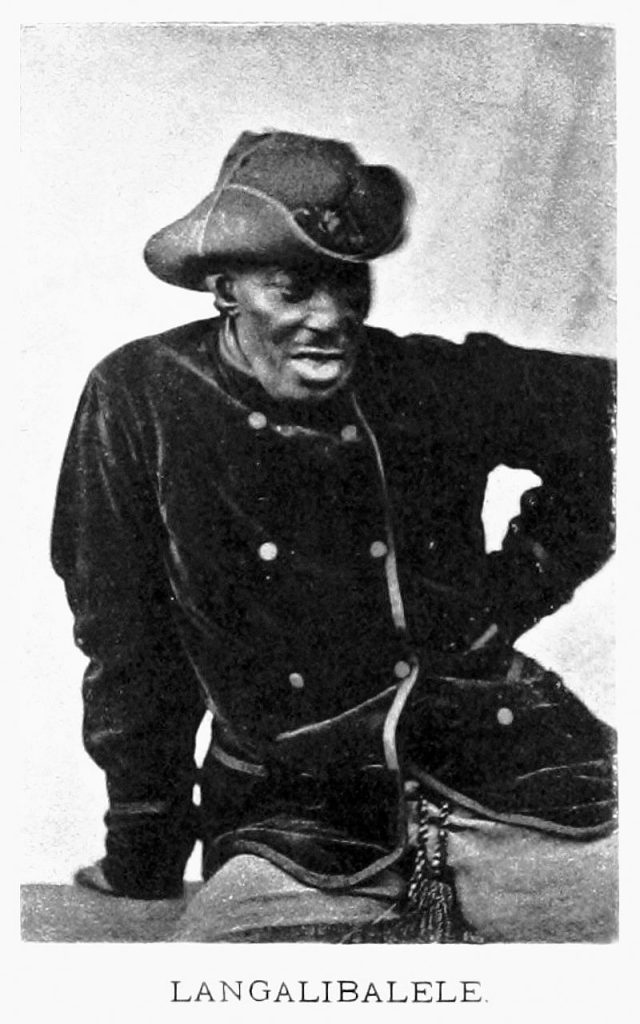
The Langalibalele Affair is perhaps the most illustrative example of how gun control was used to utterly destroy an entire people. While the Cape government was lenient and mostly unworried by black firearm ownership, Natal was very different. The Natal government was inherently distrustful of armed blacks and subjected white colonists to draconian gun control laws in an effort to prevent black firearm ownership. These laws were used to destroy Langalibalele and the amaHlubi people.
Origins and ‘rebellion’
The amaHlubi were refugees of the 1810/1820s Zulu Wars. These wars were highly destructive and destabilising for the entire north-east region, not that long before the Voortrekkers and other Europeans started to penetrate into the region. Tribes and clans were displaced and forced to migrate south and west, and the amaHlubi found sanctuary in the Natal colony. They were settled on a more permanent land reservation with good land near Estcourt in 1848 under their chief, Langalibalele.
The amaHlubi people were industrious and eager to take advantage of the colonial system to improve their lives. While some participated in the usual migrant labour system of working on the diamond mines, others were content to stay closer to home and farm. This would form the first tension. The Natal colonists needed black labour for their farms, and the amaHlubi created a problem in this regard: they did not want to be wage labour. Instead, they preferred to rent or farm their own land. The amaHlubi had westernised and joined the colonial economy as powerful actors.
The amaHlubi also fed into the broader fears of some colonists about blacks starting to outnumber the whites. The migrant labourers also used their wages to buy firearms in the more liberal Cape where the diamond mines were and brought them back to Natal. Understandably, amaHlubi with firearms now created more anxiety for Natal colonists. This was despite the amaHlubi being strategically located near the base of the Drakensberg Mountains with the job of acting as auxiliary colonial policemen. Their role here was to act as a buffer and chase away marauding bushmen living in the mountains, and protect the colony in this way. They were very effective at this job, which only added to colonist anxieties.
The amaHlubi were reluctant to fully comply and register their firearms as required. This was largely because they either did not get their firearms back, or received them back in sabotaged or damaged condition. Eventually, the screws began to be put to them. The Natal government responded by demanding stricter enforcement of firearm laws, and the Weenen magistrate decided to make sure the amaHlubi were compliant. A black colonial policeman, Mtyitizelwa, was dispatched to check on them.
Mtiyitizelwa heard gunfire from an amaHlubi settlement and went to investigate, where he found a young boy with a firearm. Mtyitizelwa tried to seize the firearm and take it to be registered, but the boy resisted. The boy said that the firearm belonged to Chief Langalibalele, not himself, and therefore Langalibalele had to consent to register the firearm. A scuffle broke out and even the boy’s mother joined the fray before the father arrived. The father supported the boy in argument: Mtiyitizelwa had to ask Langalibalele, nobody else. Chiefs were the one type of black that could get easily firearm permits in Natal, as it was a hallmark privilege of their power.
Mtiyitizelwa was committed to registering the firearm immediately and tried to argue further. The boy responded by loading the firearm and taunting Mtiyitizelwa with “If you want this gun, come and get it, and I will put you to rights”. Getting nervous, Mtiyitizelwa asked the father to take away the firearm before someone got shot. Unfortunately, the father refused by saying that the boy would shoot both of them if they were not careful, for “these boys do not respect me”.
Mtiyitizelwa finally gave up and went directly to Langalibalele who also scolded and chased him away. Langalibalele said that Mtiyitizelwa had ‘startled and antagonised his people, created wild animals out of them, and put them on guard’. Langalibalele wanted nothing to do with the dispute because of how Mtiyitizelwa had made a bad situation even worse. Mtiyitizelwa should have come to him from the beginning rather than try sort it out himself.
When Mtiyitizelwa reported back to the Weenen magistrate, the government made its demands clear: surrender amaHlubi firearms for registration. Langalibalele refused, saying that his people had laboured and worked hard and fairly to acquire the firearms. It showed a remarkable understanding of the relationship between labour and property rights. Langalibalele was also not stupid, because he had noticed that the same zeal for firearm law enforcement was not being applied to the Pondo and Zulu. He saw what was coming: the Natal government wanted to punish the amaHlubi as an example to other black groups.
Langalibalele decided to pre-empt the government and his cattle with the Ngwe while he and his people initiated a migration to Basutoland to find sanctuary. He had already been summoned to appear before Lt Governor Pine and refused, and now the government was upset. They discovered the cattle hidden with the Ngwe and destroyed them for their complicity in the ‘rebellion’, and then pursued the amaHlubi with a vengeance. The pursuing force was made up of volunteers and auxiliaries, not regular Natal forces. Lacking discipline, they tortured and killed many amaHlubi stragglers that could not keep up with the flight to Basutoland. When the survivors reached Basutoland, they were immediately handed over to the Natal government: Basuto chiefs had been bribed.
The trial
Langalibalele’s trial was anything but a trial. If the amaHlubi could be found guilty of rebellion, there would be grounds to drive them off their land and force them into wage labour. A small issue over firearm registration was starting to end in labour land expropriation. Bishop Colenso would be a vocal and ardent defender for Langalibalele, partly out of indignation of Langalibalele’s unfair treatment, and partly out of concern for the damage the government was doing to missionary work.
Colenso identified that the amaHlubi were in fact entitled to both firearms and their independent spirit, and criticised the government for forcing the amaHlubi to grovel before Natal colonial power. Nor was it clear whether Langalibalele should be tried under customary law or English law. The government decided to use both, defeating the purpose of each.
The trial was highly irregular. State witnesses lied under oath and the judge was improperly appointed, to name just two examples. Even the Great Chief who understood tribal customs and was so well respected in previous years, Sir Shepstone, attracted controversy. Shepstone was a judge of appeal on Natal legal matters, and he did not have authority to be a judge in the court of first instance. Yet, he had decided that he would be Langalibalele’s judge. He would then go on to manipulate the trial transcripts to ‘stabilise’ the government’s position, and Langalibalele did not even get legal representation.
Shepstone’s brother was also the prosecutor, and Langalibalele did not trust him. This brother had previously been a messenger for the Natal government to a tribal chief during a dispute, only to pull a revolver and arrest the chief. A shocking display of ignoring diplomatic rules and basic respect.
Langalibalele was also confused about what crime he was actually being charged with. The government tried to argue that he had ordered and encouraged amaHlubi men to bring firearms back with them so build an armoury. Langalibalele denied it, but the manipulated transcripts tried to create the image that he tacitly telegraphed it as an unspoken request to his tribe.
When Shepstone was cross-examined, the real issue turned out to be about registration of firearms and not possession. If anything, Langalibalele had committed an administrative offence, not a crime. As a chief, he was always entitled to possess firearms under Natal law. Shepstone would go on to lie in an effort to protect his brother.
Ultimately, Langalibalele could only be found guilty and either dispossessed or executed. Lt. Governor Pine went with a third option: exile to Robben Island for life. Neither Pine nor Shepstone had the power to order ‘such a severe punishment’. The punishment was so extreme that the Cape had to even amend its own laws to make it possible. The decision created an international outcry.
Colenso worked hard to push the issue into the British public eye and get them as angry about the injustice as he was. He was successful, and even the Queen herself intervened to recognise the injustice and ask that clemency be shown to Langalibalele. The scandal was enormous with even other colonial officials criticising it, and Pine was chosen to be the scapegoat for the travesty of justice. He would be recalled to London by Lord Carnarvon in 1875. Shepstone would survive because he had been identified as ‘useful’ for the coming Confederation Project.
Conclusion
The exposure of the sham trial also created an opportunity to completely reform the Natal legal system in respect of native affairs. Customary law was codified, and Shepstone’s unique power as ‘Great Chief’ was abolished and replaced by a Native High Court. Black subjects of Natal were to now be subject to a concerted westernisation effort, rather than ‘at their own pace’. They were also to be clearly targeted for political and economic subjugation, rather than seen as individuals with agency.
The amaHlubi had started to prove the most ardent and exploitative colonialists wrong: with the correct mindset, black people were very capable of becoming strong and powerful economic and political actors. They could be so successful that they created an economic threat to established colonist farmers. Add firearms to the mix, and such successful blacks started to a bit too powerful. Gun control therefore became the way to undermine their power.
The Queen’s plea for clemency would be partially successful. Langalibalele was moved from Robben Island and placed into exile on the Cape mainland. He was settled on a farm on a desolate area of the Cape Flats, where he spent most of the rest of his life. He would become something of a tourist attraction. As he got older and nearer to death, he requested to return to ‘see Natal one last time’. His request was granted and he returned and died three years later in 1889. The Cape Flats farm at which he spent many of his remaining years came to be known as Langa.