

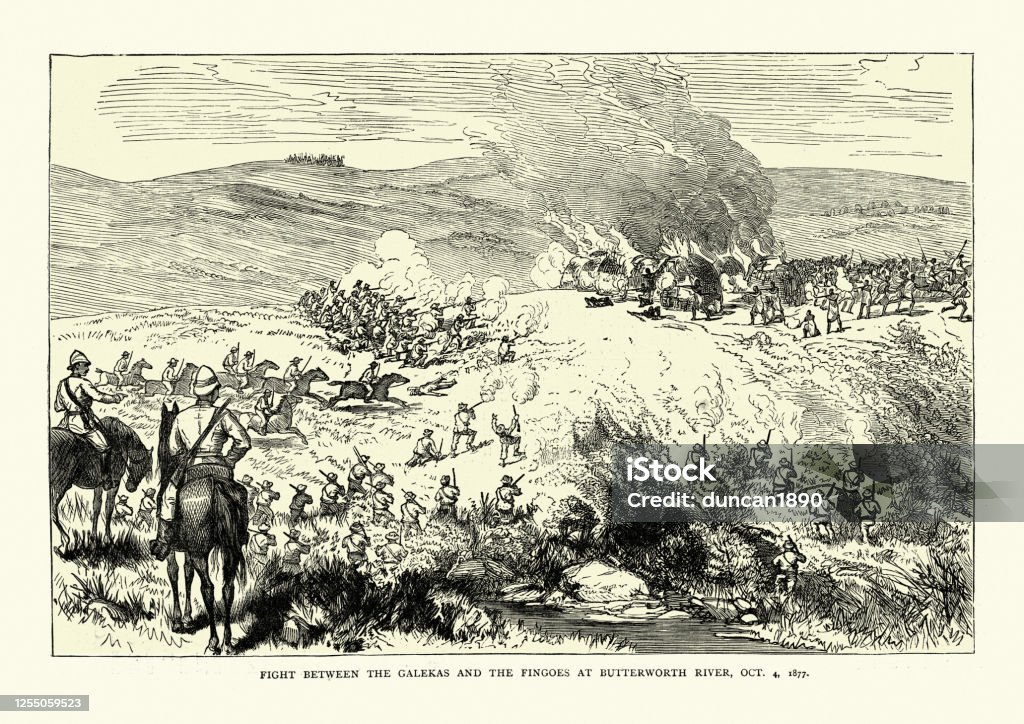
The Cape Frontier Wars were a series of wars of aggression, depending which way you look at them. They occurred between the Cape colonial government and the Xhosa clans (of which the first few wars involved the Dutch colonial company administration of the Cape). These wars would come to play a pivotal role in shaping firearm regulation to bring it in line with the rest of pre-Union South Africa. In this article, Jonathan takes us on a tour of the Cape’s Eastern Frontier.
These wars all occurred around the Zuurveld, which is the area around Grahamstown, Queenstown, Uitenhage, Fort Beaufort, and Somerset East. The story of the Zuurveld is a tumultuous one of pressure and counter-pressure. Both Xhosa and colonist coveted the fertile land, for which the Xhosa felt entitled to by tradition and culture, and the colonist for colonial agriculture of a growing colonial economy. As the Cape’s economy grew, so did its population. With an increasingly complex society beginning to form, the Cape frontier boundaries also began to move ever-more inland and up the east and west coasts.
The expanding boundaries were always going to bump up against claims to land held beyond them, and the Zuurveld was no different. Frontier colonists created settlements to support their farming activities, and this is where the friction would occur. The Xhosa were not a settled people and would move from place to place as they needed, which usually occurred after they had depleted the soil of all nutrients. The soil would largely have recovered by the time they returned to a previous spot along the trail of their wanderings, and the frontier would also be closer.
Conflict usually took the form of cattle theft and counter-theft. It is not always clear who stole whose cattle first, but it is safe to say that both colonist and Xhosa alike engaged in the opportunistic practice. When it happened, the other side would usually respond in kind. Government treaties with the Xhosa were difficult to enforce and monitor, and the government could also be accused of bungling some of these treaties by not fully understanding the Xhosa culture.
Major wars included 1820, 1835, 1846, 1852, and 1875. There were many wars and their numbering is quite arbitrary. All could be said to be motivated by the Zuurveld land question. The 1820 war is perhaps the greatest of the wars for the Xhosa, in which they besieged and nearly captured Grahamstown. The brutal and bloody fighting would ultimately end when the Xhosa prophet, Makhanda, surrendered himself to the colonial government in an effort to stop the bloodshed. Colonial historians write favourably of Makhanda, even calling him a great and noble individual.
Unfortunately, the failure at Grahamstown would be the closest the Xhosa came to a major victory against the colonial government. The Xhosa would almost always have great success in the early stages of later wars, largely because they had the element of surprise and the colonial government had a strong wish to believe that peace would hold. The wars were always very destructive and traumatic for both sides involved, and the Xhosa would quickly run out of momentum and desire to fight after their early success. Their military doctrine appeared to be loosely organised, and their enthusiasm stemmed almost entirely from the will of their clan chiefs. Their ability to follow-through and prosecute an organised war undermined their abilities.
The Zuurveld land was not the only cause of friction and conflict. The 1810 and 1820s Zulu wars in the Natal area were extremely destructive for other black tribes in the area. The Zulu war machine was extremely well organised and disciplined, and united. The result was the total shattering of many once established smaller black tribes, and many of these surviving remnants would settle on Natal’s native reservations under the authority of Natal Lt. Governor Shepstone. Other remnants would trickle further south along the coast and come into contact with the Xhosa.
These shattered remnants shared no common tribal affiliation, and were really little more than a hodgepodge of different tribes and peoples just trying to find peace and security so that they could re-establish themselves. This new mish-mash collective would come to be called the Mfengu, and were often also simply referred to as Fingoes. The Xhosa were their first opportunity to pause their migration and regather their thoughts, so to speak. Unfortunately, the Mfengu were not welcomed by the Xhosa chiefs.
The Xhosa were not a settled people, and not suited to a modern settled economy. Even if they were, they did not understand principles such as soil nutrition and how crop rotation could allow a people to settle and never need to move again. Even the Europeans were arguably new to organised methods of crop rotation with the three-field system becoming common between 500 and 1500 AD, even if crop rotation was an ancient concept that was not well understood.
This lack of modernity so essential to growing populations and more complex society meant that the Mfengu placed a strain on resources. The Mfengu became little more than a servile people merely attached to the Xhosa tribes. They were resented as unnecessary and unwanted additions, and the Xhosa chiefs were already little more than despots. As the colonial frontier began to rub up against the Zuurveld, the Mfengu began to desert their Xhosa overlords at the first opportunity they got. The colonial economy offered the Mfengu a truly new life in which they could work for wages, that they could then use to buy primitive luxuries that they did not need to make themselves.
The Mfengu began to westernise by living a settled and industrious lifestyle, making things to trade and sell. The Mfengu were very grateful for the opportunities provided by the colonial system, and showed their gratitude by enthusiastically partaking in the colonial economy. They also showed their gratitude by becoming auxiliary colonial policemen, and the colonial government settled them along the frontiers as a buffer between the colonists and the Xhosa.
This created even more resentment for Xhosa chiefs, as they saw their former ‘dogs’ prospering quite well, while the Xhosa were struggling. The moving frontiers began to box the Xhosa in, and every war they fought brought more ruin upon them. The land they could freely move around in got less and less, and the already strained resources also became less and less. Traditional Xhosa society was not built to maximise limited resources without significant reforms that would be seen as undermining the traditional Xhosa way of life.
Related to ‘undermining traditional lifestyles’, was the direct social effect of the colonial economy. As life became more and more difficult for the common man and woman of the Xhosa tribes, they began to defect from their tribes and moved into the colony to find work and do as the Mfengu were doing: modernise and westernise. Some of these individuals were no doubt happy to benefit from the fruits of the colonial system, but not all of them. As the chiefs began to lose more and more of their people to the colonial economy, they felt their authority being undermined and their grip on power and influence slipping ever more.
To make matters even worse for the chiefs was that even though they were nominally beyond the frontier, the colonial legal system began to severely reduce their power. Whatever authority was vested in them by tradition, and moderated by councils of elders, was moderated even further by western legal principles.
Xhosa aggression and enthusiasm for the wars was driven almost entirely by the force of personality and powers of the chiefs. The various clans did coordinate prior to going to war, but were far too decentralised to be effective in the long term. By comparison, the Zulu were enough of a united war machine to deter the colonial frontiers of Natal from excessive expansion. The Sotho suffered badly in their wars with the Orange Free State, but once they were pushed into the Drakenberg mountains, they had a natural fortress from where they formed a new tribal identify and invested heavily in modern war tactics. The Sotho would go on to become expert marksmen and equally effective with armed cavalry.
The Xhosa were none of this. They acquired firearms sporadically, but never sought to modernise their fighting against modern colonial forces. The influence of the chiefs seem to have kept them firmly rooted in the old way of doing things. The Xhosa were also fighting in the open plains of the eastern frontier, where modern field tactics hopelessly outclassed them. Their military effectiveness was accordingly limited to guerilla tactics, which irritate rather than win. As the colonial behemoth consolidated itself, the guerrilla tactics became less and less likely to be anything more than a small thorn in the side.
After a failed war, the Xhosa would rest for the bare minimum amount of time to regather their strength, and try again. Their tactics seldom evolved or improved, and they of course would lose the next war as well. Then they would do it all over again. Until the 1870s, the Xhosa had always been banished from the Zuurveld area before being allowed to return and remain ‘on sufferance’ by the colonial government.
By 1875, the Xhosa were ready for another great big push. Despite all the warnings, the colonial government seemed to be in denial about the possibility of another war. The war started badly for the colonial government, largely because of poor planning and inefficient use of military resources. Once Frere intervened and removed Molteno, things changed. The war effort was centralised and prosecuted to great success. One of the most rebellious chiefs, Sandile, was killed during fighting. When the war was over, the great question was what to do with the Xhosa.
The Cape parliament debated the issue at length. While everyone agreed that the Xhosa had to be punished, some were more animated than others. Some of the more animated politicians demanded severe and immediate dispossession of the land. Others were more pained, and admitted the cultural significance and entitlement the Xhosa had to the land. The impression of these more sympathetic politicians was that they really did not want to banish the Xhosa, but they also understood the frequent wars needed to end and wanted to remove a reason for the wars.
It was decided to banish the Xhosa. With the total deprivation of the land, and the absence of chiefs such as Sandile, the wars were over. There was no longer any reason to fight, and no agitation to encourage it. The Cape would further pass the 1877 Gunpowder Amendment Act and Peace Preservation Act to ensure continued peace. The PPA would go on to be used to completely disarm the Xhosa of any firearms they had as well as every other black in the colony.
The reason for this was because of the perception by some colonists that firearms ‘caused’ the Xhosa to rebel because it ‘made them think they could parry with the white man’. This thinking ignored the very complex and difficult social problems the Xhosa were faced with. There is certainly a degree of fault of the Xhosa chiefs for their obstinate failure to read the writing on the wall and adapt much like the other great tribal powers like Zulu and Sotho had, but can they really be blamed? Criticism is of course often in hindsight.
With the disarming of the Xhosa followed by all the other black tribes in the Cape, only the Zulu and Sotho remained as potential problems for further domination. Natal would deal with the Zulu in the Anglo-Zulu War, and the Cape would try to deal with the Sotho in Basutoland through the BaSotho War of the Gun. While the 1875 Cape Frontier War had no been part of the Confederation Project, it had lined up quite nicely for Frere’s purposes: the Xhosa had given him a licence to remove them as an obstacle and bring greater alignment for uniform native and firearm policies.